
Why Does Waterproofing Fail? The 6 Most Common Reasons and their Solutions
You paid for waterproofing, waited through the work, and a few months later the same stain is back on the ceiling. It is frustrating, and many property owners in Dubai go through it. Early failure almost always has an identifiable cause, and in most cases, it can be fixed properly. This blog explains why waterproofing fails so soon, what to do first, and what a professional waterproofing service in Dubai looks like, so you know what to expect.
Why Waterproofing Fails Early?
Early Failure Is Usually a Process Problem
Waterproofing is a service where quality work matters as much as anything else. Most early failures trace back to decisions made before, during, or just after application: how the surface was prepared, how the leak was diagnosed, and how the details were finished. A professional waterproofing company provides reliable waterproofing services to stop water seepage and make your property secure.
Is It the Same Leak or a New One?
Before assuming the work failed, check where the water is appearing. If the stain is in the same spot, the original cause may not have been fixed. If it is somewhere new, water may be entering through a different weak point that was never part of the original job. Our guide to the /signs-your-roof-needs-waterproofing/ can help you read what you are seeing.
Why Dubai Conditions Make Waterproofing Fail Faster
Every day, surfaces expand and contract due to extreme heat. During heavy rain, humidity keeps moisture trapped in exposed areas. In this climate, a small flaw in waterproofing work tends to show up in the first rainy season instead of years later.
Problems That Start Before the Work Begins
The first two causes happen before any waterproofing is applied, and property owners ignore them.
Cause 1: Poor Surface Preparation
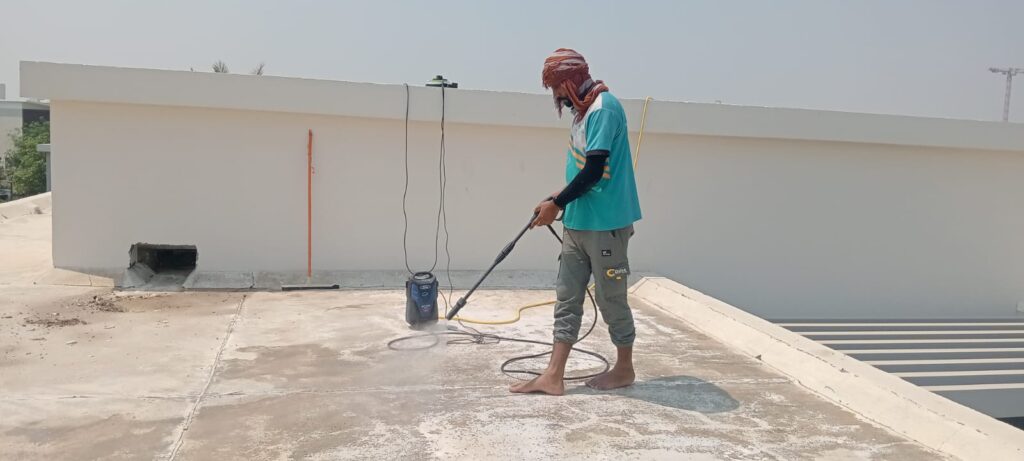
Waterproofing needs a clean, sound surface to bond to. If cracks or old failing layers were not repaired, or the surface was dusty, damp, or uneven, the new layer may not stick properly. It can look fine on completion day and start lifting or leaking months later.
Cause 2: The Source of the Leak Was Ignored
Water often shows up far from where it enters. A stain on a ceiling may come from a balcony drain, a roof edge, or a pipe penetration far from the stain. If the contractor treated where the stain appeared rather than the water source, the leak simply continues. A proper job starts with finding the actual entry point.
Problems During Application
Cause 3: Thin Coverage or the Wrong Approach for the Surface
Each surface behaves differently. Concrete roofs, balconies, bathrooms, and metal roofs all need an approach suited to how they move and where water collects. Applying too thinly, skipping layers, or using a one-size-fits-all method can leave weak spots. This is especially true for metal, where metal roof waterproofing in Dubai needs to account for expansion, movement, and corrosion.
Cause 4: Weak Detailing at Joints, Corners and Drains
Most leaks begin where the roof meets a wall, around drains, pipes, and vents, and at corners and edges. If these areas were rushed or left with only a quick sealant bead, they become the first points of failure.
Problems During Application
Sometimes the waterproofing itself was fine, but something afterwards undermined it.
Cause 5: Poor Drainage and Standing Water
Water that cannot drain sits on the surface and puts constant pressure on the waterproofing. Blocked or badly positioned drains, and surfaces with poor slope, can cause ponding that wears down even good work. Drainage is a design and maintenance issue that a thorough inspection should check.
Cause 6: Damage or New Penetrations After Completion
Later work such as new fittings, satellite dishes, solar or AC installations, or heavy foot traffic can puncture or stress a waterproofed surface. Without regular checks, small damage goes unnoticed until water gets in.
What to Do First If Your Waterproofing Has Failed
Document Everything
Take dated photos and videos of the stains, the affected areas and the surface, and note when the leak appears, for example after rain or when the AC runs. Keep the original quote, invoice, completion report, and any photos from the first job.
Get a Proper Inspection
Do not authorize another patch before the cause is identified. An independent inspection by an experienced waterproofing company in Dubai can tell you whether the original work failed, whether something else is causing the leak, and what the realistic fix is.
How a Professional Re-Do Is Handled
A re-do is not simply applying more of the same on top. A well-run repair follows a clear sequence.
Step 1: Root-Cause Inspection
The technician examines the affected area and the surrounding surfaces, checks drainage and details, and identifies where water is actually entering. The findings should be explained to you in plain language.
Step 2: Deciding What to Remove and What to Keep
Depending on the condition of the existing layer, the repair may involve removing failed sections, repairing the substrate and rebuilding the affected areas, or in some cases treating the whole surface again. A sound existing layer may be kept; a failing one should not be covered over and hidden.
Step 3: Re-Application, Testing and Handover
After preparation and application, the work is allowed to cure and then checked, with a water test where practical. You should receive a completion report with photos and clear warranty terms. If mold has developed in the meantime, it should be treated as well; see our mold removal service.
Why Inspection Comes First at Home Comfort
We start with a free site inspection so that we can find the cause before any estimation. If you are looking for the best waterproofing company in Dubai for a recurring leak, ask any provider, including us, to show how they will prove the cause before they promise a fix.